
Questions and answers
obsQRity™ is pronounced "obscurity."
What is obsQRity™?
A daily puzzle played on a real QR code. QR codes are built to survive damage, and the game is finding out how much. Each move, you tap a light area of the QR code to color it in dark. Your score is how many safe moves you make before the QR code stops working.
Is it really a real QR code?
Yes! Every puzzle is a working QR code, and it stays one while you play, right up until you break it. Point your phone's camera at it and it opens that puzzle's own link, like obsqrity.com/1.
Why does a damaged QR code still work?
QR codes are designed with Reed-Solomon error correction, the same math that lets a scratched CD keep playing. The code stores extra information so it can repair damaged data. But there's a limit, set by the QR code standard: damage more than that and the code is broken. Some phones may still squeeze a reading out of a broken code, but the game plays by the standard. That limit is what you're playing against.
What's a brick?
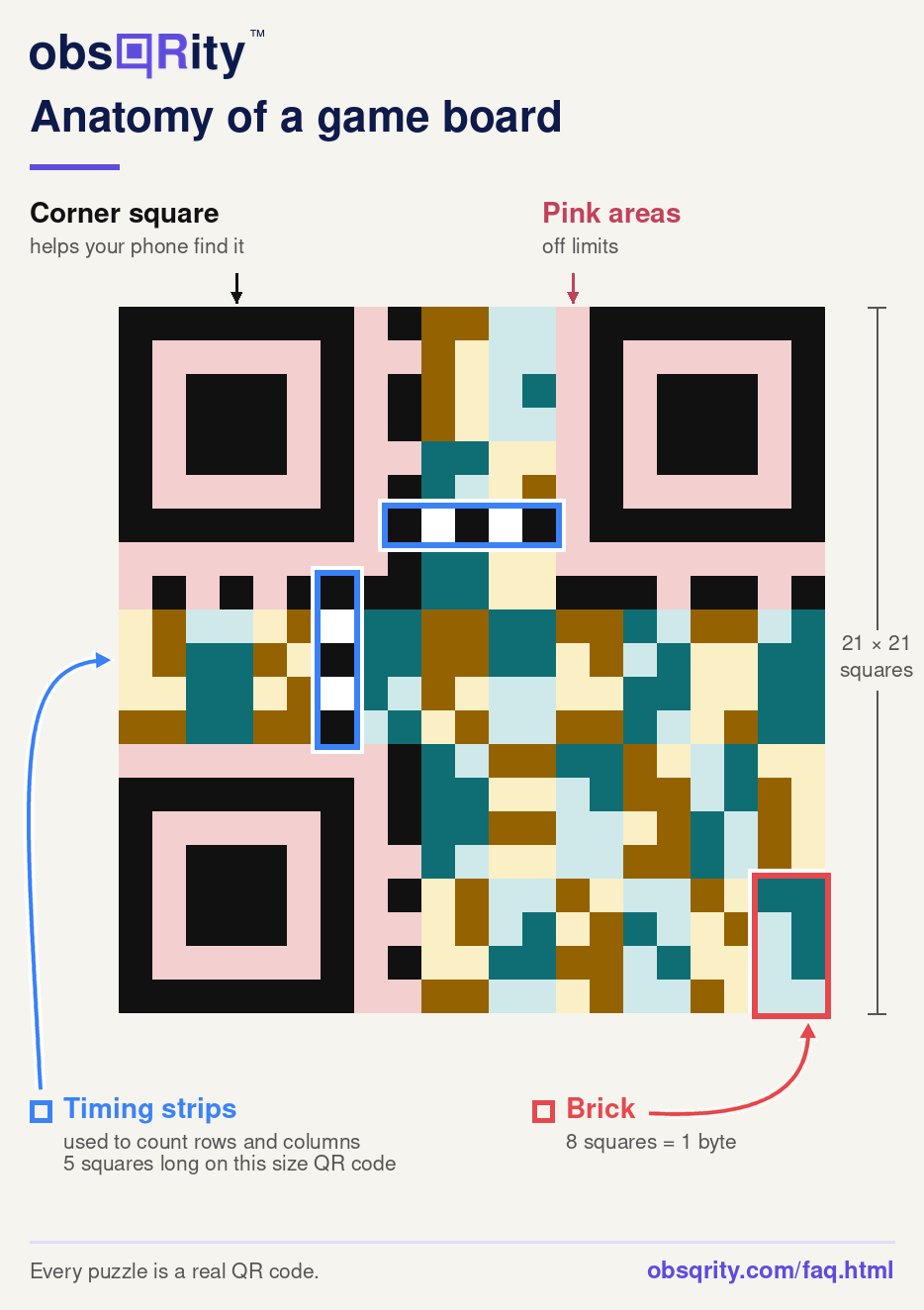
A QR code stores its data in bytes: each square is one bit, and 8 squares make a byte. In the game I call them bricks. Damage any square in a brick and that whole brick counts as damaged. Each puzzle tells you how many bricks it can lose under the standard, and if you go one past that, the code is broken.
What's a free move?
A move only counts the bricks it newly damages. So if an area sits completely inside bricks you've already damaged, it's a free move.
Why are some areas pink?
Pink areas are out of bounds. They're the parts of the code that help your phone find it and read it. Only the bricks hold your data, so only bricks can take damage.
How do you know the maximum?
For every puzzle, a computer works out the exact best possible game: the most safe moves anyone can make. Then we check that result with real QR code readers to make sure the code still scans. So the max isn't a guess. If you hit it, that's a perfect game.
Can't I just play this on paper?
Yes, absolutely, and that's how it started! Print today's puzzle on one page, color in one area at a time with a black marker, and scan it with your phone after each move. If it still shows a link, the move was safe. Your phone is the referee.
The printout also gives you what a plain QR code can't: the best possible result and a map of the bricks. Picking which areas to fill so you get the most moves without breaking it is a hard math problem: the number of combinations explodes quickly. We solve that for every puzzle so you have a real target to aim for.
Can I use it to teach?
Yes, and I'd love that. obsQRity is a hands-on way into a few big ideas:
- Bits and bytes: every square is a bit, and each brick is a byte. Coloring in a single square is a bit flip, the most basic form of data corruption.
- Reed-Solomon error correction: invented by Irving Reed and Gustave Solomon in 1960, it's why a QR code still works with part of it missing. The same family of codes protects CDs and DVDs, and brought back Voyager 2's pictures of Uranus and Neptune. Every puzzle shows exactly where that protection runs out.
- Optimization: finding the best result under a fixed budget, the kind of problem computers solve with integer programming. That's how the most moves for each puzzle is found.
It works on paper too: print today's puzzle on one page, let students color in areas with a black marker, and scan after each move to see if the code survives. It's free to print and copy for classroom and personal use. If you use it in a class, I'd love to hear how it went at hello@obsqrity.com. There's more on the page for teachers.
When does a new puzzle come out?
Every day at midnight, your time.
What are the difficulty levels?
Easy and Medium play the daily puzzle: Easy shows the bricks in color, Medium hides them, but you can peek. Hard is a bigger puzzle of its own (25 by 25 squares), and you can still peek. Nightmare is the biggest (29 by 29): study the bricks as long as you like, but once you make your first move, they're gone. Each puzzle has its own result. Want a challenge on any level? Turn on Race the clock in Settings, in the menu.
How are Sunday's puzzles different?
Every puzzle is one size bigger: Easy and Medium play 25 squares across instead of 21 (44 bricks instead of 26), Hard plays 29, and Nightmare 33. Each bigger code also has a small helper square near one corner with a pink ring. That's out of bounds too. The bricks have to bend around it, so the bigger codes' bricks come in odd shapes, making the strategy and layout trickier. More bricks also means a longer game, but the rules remain exactly the same.
Can I play it again?
Sure, tap Play again. Your first finished game of the day is the one that counts and the one you share.
Is it free? Do I need an account?
It's free, and there's no account or sign-up. It runs right in your browser. Your scores and streak are saved on your own device.
Who made it?
I did! I'm Patrick Keane, and I came up with obsQRity at my kitchen table, scribbling on a newspaper ad early one morning. You can find me on LinkedIn.
Did you use AI to build this?
Of course I did! After I had a working prototype using just paper and a pen, AI helped write the code and check the math. The rules haven't changed a bit, and every design decision since has been mine.
How do I get in touch?
Email hello@obsqrity.com or follow @obsqrity on X. I'd love to hear what you think.